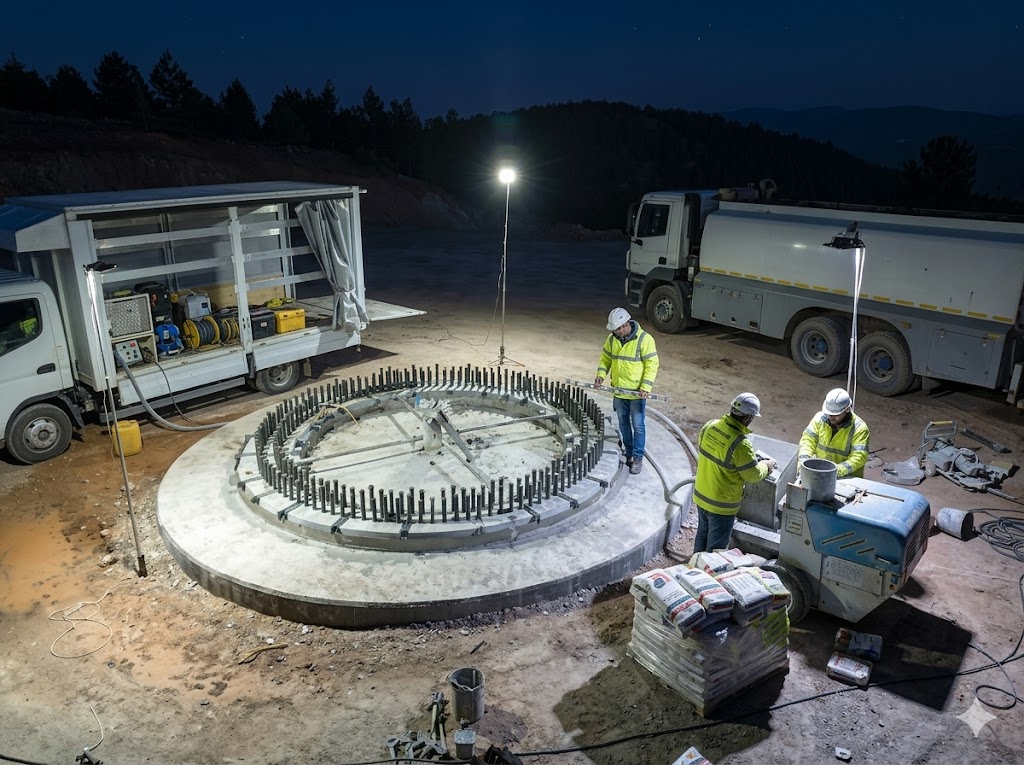
Grout application in wind turbines is one of the most critical engineering stages in ensuring structural integrity. Grout is essentially a high-strength, non-shrink special mortar that fills the gap between the steel tower of the wind turbine (or the tower anchor cage) and the reinforced concrete foundation, taking on the role of load transfer.
The safety and longevity of massive wind turbines depend on the correct design and application of this thin but vital connection layer.
Wind turbines are exposed to constantly changing and repetitive forces. The main functions of the grout layer are as follows:
Load Transfer: To homogeneously transmit the massive dynamic loads (bending moments, shear, and torsional forces) created by the wind and rotating rotor blades, along with the turbine's own static weight, from the tower base to the reinforced concrete foundation.
Elimination of Tolerances: To provide full contact by filling the millimetric production and casting elevation differences between the steel tower flange and the reinforced concrete foundation surface without leaving any voids.
The grout material used in wind turbine foundations must possess engineering properties far superior to ordinary concrete or mortar. In accordance with the specifications of turbine manufacturers (General Electric, Vestas, etc.), it is expected to provide the following characteristics:
High Compressive Strength: Early and final compressive strength generally between 80 MPa and 120 MPa (or higher depending on the project).
Fatigue Resistance: The capacity to maintain structural integrity against millions of cycles of repeated vibration and wind loads.
High Flowability and Cohesion: The self-leveling ability to flow into narrow and reinforced areas without bleeding or segregation.
Non-Shrink Structure: Providing excellent adhesion to steel and concrete surfaces by not undergoing volumetric shrinkage during the setting and subsequent curing phases.
The success of the field application depends on the strict control of environmental factors and pouring procedures as much as the quality of the material.
Surface Preparation: The concrete foundation surface must be freed from the weak laitance layer (by milling or roughening) and cleaned. Before pouring the grout, the surface must be saturated with water, but no free-standing water should be left on the surface.
Formwork and Sealing: Due to the high flowability of the grout, sturdy, leak-proof formwork that allows for air evacuation is installed to prevent leakage.
Mixing Process: The process is carried out with high-speed, special grout mixers to ensure the homogeneity of the material. The mixing water temperature and ambient temperature (generally 5°C to 30°C is ideal) directly affect the setting time and flowability of the material.
Pouring (Pumping/Pouring): To prevent air entrapment (leaving air bubbles), the pouring process must be carried out continuously from a single direction only. Pouring or pumping continues until the material comes out from the other side of the formwork.
Curing: After the pouring is completed, the exposed grout surfaces must be protected with curing compounds or wet burlap to prevent rapid evaporation and cracking, and insulation must be provided against extreme heat or frost hazards.
Compliance with technical specifications is as vital as material technology for the flawless progression of the application in the field. In this context; are you more interested in the material content optimization side (for example, ultra-high strength and the use of silica fume), or directly in the management of specifications in field pouring operations?